

Folks
Under normal wall power (Adafruit 27W P/S) everything is fine. The set up is a PI 5, L3V7 board and the 1743 LCD screen. When trying to run the power to the PI 5 (even with LCD screen disconnected) using a Witty 4 L3V7 output (P3-1, P3-6) to not hot switch the 5V to the PI (SD will get messed up), the PI starts a boot then goes red and the L3V7 output goes to zero at times. Attached the handoff from CLAUDE about all that was done. It contains all the efforts, details and failures in finding out the issue...the wires output of the L3V7 are under 8" to the PI via a 5978 adapter into the PI 5 USB micro. It was a painful experience as you will see in the attachment. All the mods made by Claude have been reset as noted at the end of the pdf. As noted, all wires from the L3V7 to the PI had been disconnected at times. L3V7 pins 3,5,7,8,11 (7 is tied to the Signal SWITCH on the L3V7)...these have been isolated and at times not even used. L3V7 is not configured as a HAT but on its own.
Jay

From what you have described, I don't think the L3V7 cutting its output several seconds later is the original cause of the problem. On Raspberry Pi 5, the LED changing from green to red normally means the Pi has entered its low-power standby state. Your scope observation also indicates that the L3V7 output was still present when the Pi changed to red, with the output being switched off only afterwards.
The main thing I would suspect here is the power path itself.
Your current setup -- powering the Pi 5 from the L3V7 P3 output through external wiring and an Adafruit 5978 USB-C breakout -- is quite different from the normal/recommended Witty Pi installation. With a Pi 5, resistance in the wires, connectors, breakout board and contacts can become significant during the higher current transients that occur while Linux is booting. A supply may measure perfectly well at the L3V7 output while the voltage actually reaching the Pi drops momentarily.
If you want to verify this, the useful place to monitor is the 5V rail on the Raspberry Pi itself (for example at the 5V GPIO pin), preferably with an oscilloscope during the boot process. Measuring only at the L3V7 output does not include voltage drop across the external wiring and connectors.
The fact that the bootloader can remain running with the SD card removed does not rule this out, since the load during a full Linux boot is considerably different.
That said, this wiring arrangement and the additional USB-C breakout/interface circuitry are outside the normal supported use of Witty Pi. I can point out likely causes and clarify Witty Pi behaviour, but troubleshooting the complete custom power-delivery arrangement would go beyond the scope of Witty Pi product support.
Subject: Witty Pi 4 L3V7 charges but will not run from battery
I've been working on this for several months. I've now removed the Pi 5's heatsink and mounted the L3V7 directly onto the GPIO header as a HAT, rather than wiring it over to the side. Mounted that way it boots reliably every time, so that part is finally sorted. Thanks for the info making me go a different route.
The remaining problem is the battery. I'm running two 21700 cells in parallel, roughly 5000 milliamp hours each, hard-soldered to the P2 fly leads that came with the board. They're fully charged and resting at 4.05 volts. wittyPi.sh reports Vout 5.19 volts, Iout 0.64 amps, charging normally.
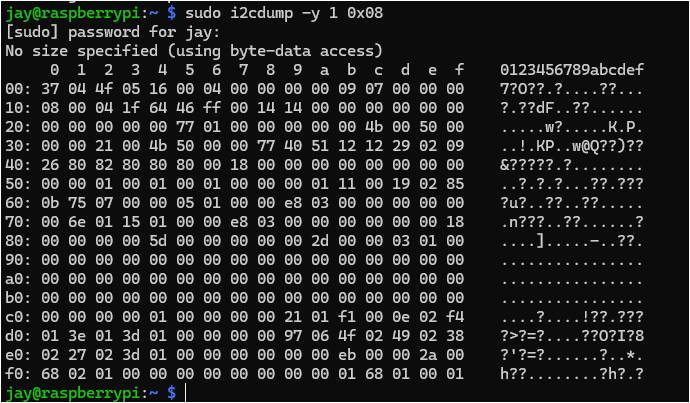
When I remove AC power the Pi dies instantly. Pressing the L3V7 button, the PI red LED flickers for a split second and then nothing. Every thing goes off. I've put a meter across the battery terminals while pressing it and the voltage doesn't sag at all — it sits steady at 4.05 to 4.13 volts, so the board isn't drawing any current from the cells. An i2cdump shows register 8 at zero, meaning the last shutdown was not a low-voltage cut, and the low-voltage threshold is set to 3.1 volts. Default state is off, power cut delay 7 seconds, nothing unusual in the settings. See attachment
So the board continues to charge the batteries (there were both charged outside and both were 4.05 so they were equal) but will not discharge from it. Is this a known failure of the boost converter, and is there anything else you'd like me try before weI call the board faulty?
Jay
Please be advised I am dropping the L3V7 and going with a PI HAT+ for the PI 5 plus a 2S system for the two 21700 batteries. It's easier, less complex and won't require discrete components I had to control the L3V7 SWITCH input. The HAT+ has the necessary software to control power to guard against corrupting the SD card.
Jay