
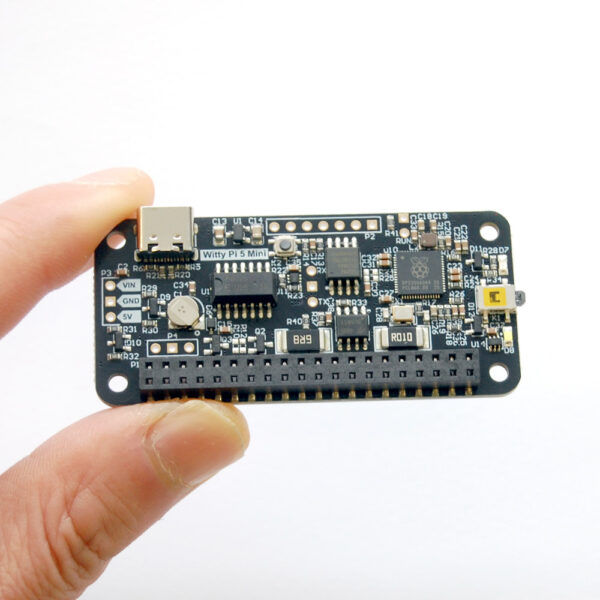
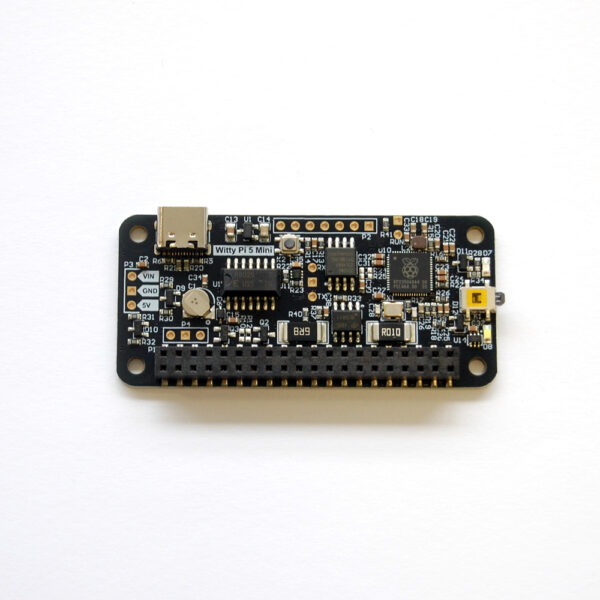
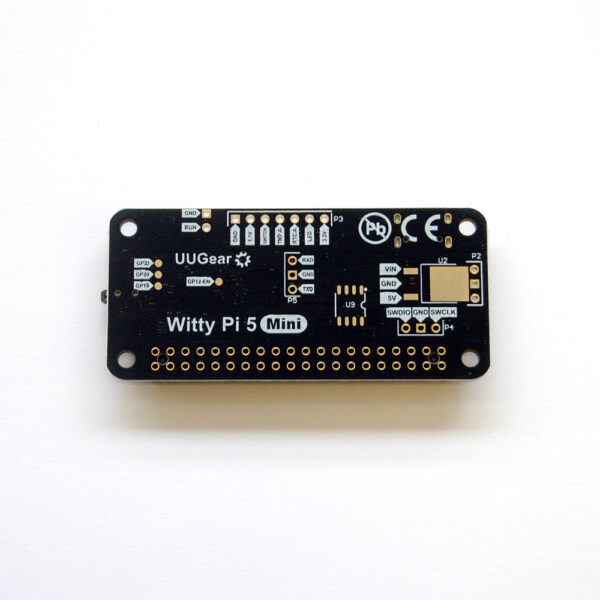
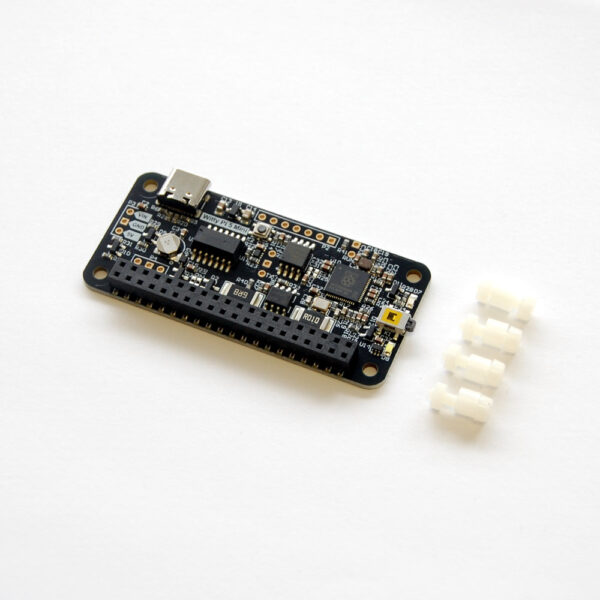
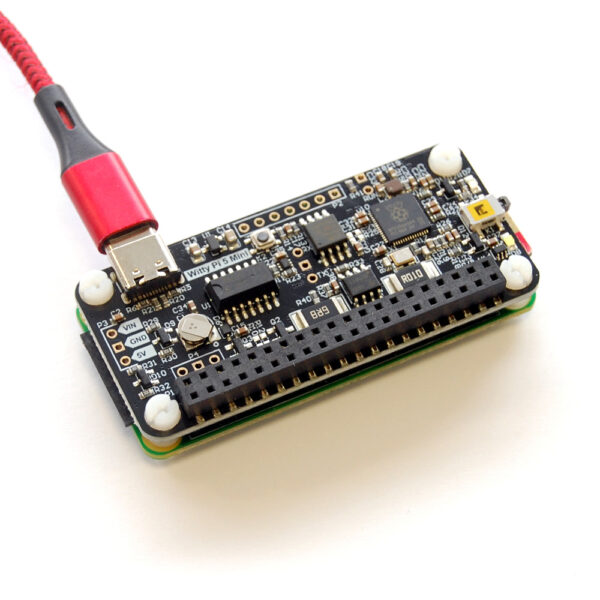
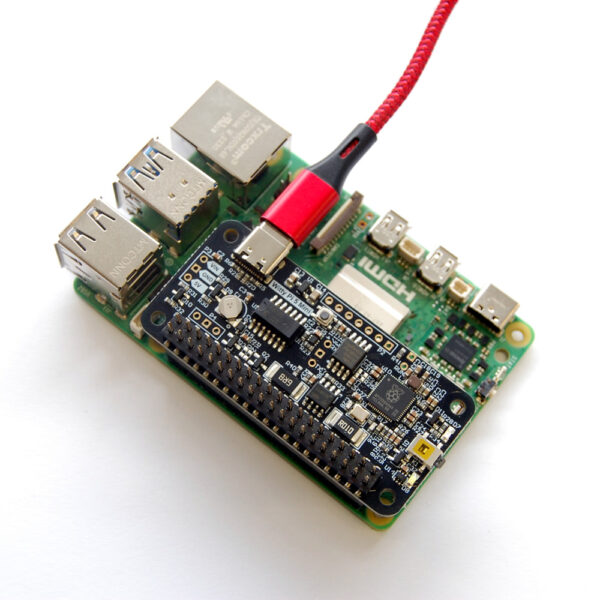
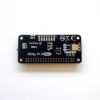
Witty Pi 5 Mini is a compact member of the Witty Pi 5 family, bringing realtime clock (RTC) and advanced power management functionalities to your Raspberry Pi.
It allows you to schedule when your Raspberry Pi turns on or off, automatically shut it down under predefined voltage or temperature conditions, and significantly reduce power consumption by cutting power when the Raspberry Pi is not needed.
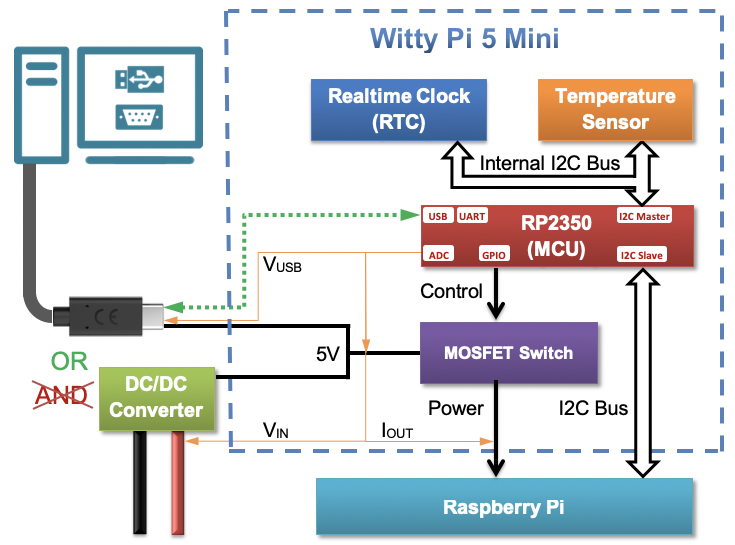
Witty Pi 5 Mini shares the same RP2350-based architecture, firmware features, and software package as Witty Pi 5 HAT+. It supports the same schedule scripts, USB-based firmware updates, onboard logging, and I²C communication.
Compared with Witty Pi 5 HAT+, Witty Pi 5 Mini has a smaller footprint and a simplified power-input design. It does not include an onboard DC/DC converter or dual-input power-path isolation. Instead, it provides a flexible interface for using an optional external DC/DC converter.
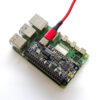
Witty Pi 5 Mini supports Raspberry Pi models with a standard 40-pin GPIO header, including Raspberry Pi Zero, Zero W, Zero 2 W, 3, 4, and 5 families. Depending on the Raspberry Pi model, an additional stacking header may be required for proper physical clearance.
3D Model (STEP file) can be downloaded here: https://www.uugear.com/repo/WittyPi5Mini/WittyPi5Mini.step
Hardware Features
- A high-precision realtime clock with an accuracy of ±3.8 to 5 ppm.
- A dedicated temperature sensor with 0.0625°C resolution.
- A 0.07F/3.3V supercapacitor for RTC timekeeping during temporary power loss.
- An RP2350 microcontroller with 16MB external flash memory.
- Up to 3A output current for Raspberry Pi and its peripherals.
- A VIN sensing input for monitoring an external power source.
- A GP12_EN signal for controlling an optional external DC/DC converter.
- An emulated USB flash drive for configuration, scripts, and logs.
- An emulated USB serial device for realtime firmware debugging.
Witty Pi 5 Mini uses only the I²C interface for communication with Raspberry Pi, leaving other GPIO pins available for your project.
Time Controlled Device
The high-precision RTC on Witty Pi 5 Mini provides accurate timekeeping even without an Internet connection.
You can schedule your Raspberry Pi to turn on and off at specific times, or create more complex schedules using script files.

Witty Pi 5 Mini supports three schedule formats:
- .wpi — defines a repeating ON/OFF sequence.
- .act — defines individual power-on and power-off actions at specific times.
- .skd — a compact schedule format executed directly by the firmware.
Unlike earlier Witty Pi generations, Witty Pi 5 Mini stores and processes schedule scripts on the board itself. The RP2350 handles the scheduling independently, even when the Raspberry Pi is turned off.
By powering down the Raspberry Pi when it is not needed, Witty Pi 5 Mini can significantly reduce the total energy consumption of battery-powered or intermittently operated projects.
With firmware v1.8 or later, Witty Pi 5 Mini also supports automatic daylight saving time (DST) adjustments. Once configured, the firmware can handle DST transitions even while the Raspberry Pi is powered off.
Temperature Controlled Device
Witty Pi 5 Mini has a dedicated temperature sensor with a resolution of 0.0625°C.
You can configure upper and lower temperature thresholds and specify whether the Raspberry Pi should be powered on or shut down when a threshold is crossed.

This allows you to build temperature-controlled systems, such as environmental monitoring devices and unattended installations.
Voltage Controlled Device
Witty Pi 5 Mini provides a VIN sensing input for monitoring an external power source, such as a battery.
When an external DC/DC converter is used to supply the regulated 5V power, Witty Pi 5 Mini can monitor the converter’s upstream input voltage through VIN.
You can configure a low-voltage threshold to safely shut down the Raspberry Pi before the battery is excessively discharged. A recovery-voltage threshold can also be configured to automatically restart the Raspberry Pi when the input voltage recovers.

Please note: VIN is a voltage sensing input, not a direct power input for the Raspberry Pi. Low-voltage shutdown and recovery thresholds apply when the board is configured to use an external DC/DC converter.
Flexible External DC/DC Power Supply
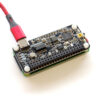
Witty Pi 5 Mini can be powered directly from a regulated 5V supply through its USB Type-C connector.
If your project uses a battery or another power source that does not provide regulated 5V, you may use an external DC/DC converter.
The external converter can be a buck, boost, or buck-boost converter, depending on your application’s requirements.
Witty Pi 5 Mini provides:
- A 5V input connection for the regulated output of the external converter.
- A VIN sensing input for monitoring the upstream source voltage.
- A GP12_EN output signal for enabling or disabling a compatible external converter.
When the external converter’s enable input is connected to GP12_EN, the firmware can control the converter according to the configured power-source mode.
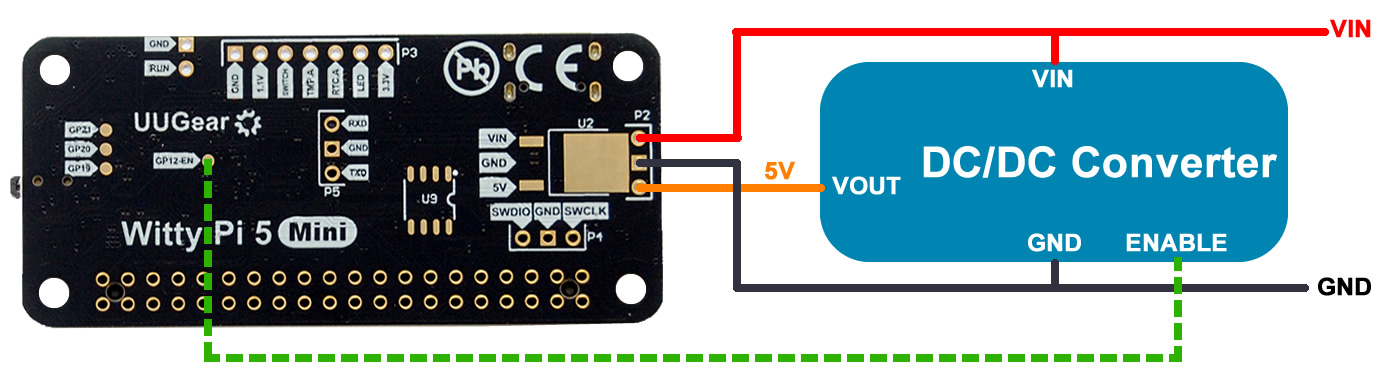
This design gives users more flexibility in selecting a power converter that matches their project’s input voltage, output current, efficiency, and physical size requirements.
Important: The USB-C 5V input and the external converter’s 5V output share the same power rail on Witty Pi 5 Mini. They are not isolated from each other. Do not connect two independent power sources simultaneously unless your external circuit provides appropriate power-path isolation or source selection.
Unlike Witty Pi 5 HAT+, Witty Pi 5 Mini does not provide built-in dual-source UPS functionality.
Supercapacitor for RTC Timekeeping
Instead of using a replaceable coin-cell battery, Witty Pi 5 Mini has an onboard 0.07F/3.3V supercapacitor to provide backup power for its realtime clock.
The supercapacitor can keep the RTC running for a limited time after external power is disconnected.
This eliminates the need for a CR2032 battery and makes Witty Pi 5 Mini convenient for applications where replacing a backup battery is undesirable.
The backup duration depends on the capacitor’s charge level, leakage, and operating conditions. The supercapacitor is intended for RTC timekeeping only; it cannot power the Raspberry Pi during an outage.
Single I²C Slave Device
Witty Pi 5 Mini uses the RP2350 microcontroller as an I²C slave device, with a default address of 0x51.
The Raspberry Pi communicates with Witty Pi 5 Mini through this I²C interface to read measurements, configure operating parameters, schedule power actions, and issue administrative commands.
The RP2350 also communicates with the RTC and temperature sensor through an internal I²C bus. Their registers are mapped into the I²C register space presented to the Raspberry Pi.
- RTC registers are mapped to virtual registers #80–#95.
- Temperature sensor registers are mapped to virtual registers #96–#103.

This architecture allows the Raspberry Pi to access the board’s functions through a single I²C slave device without using additional GPIO control signals.
Easy Firmware Updates and Debugging
Witty Pi 5 Mini is based on the RP2350 microcontroller, making firmware updates very easy.
To update the firmware, simply hold the BOOTSEL button while connecting the USB-C port to a computer. The RP2350 will appear as a virtual USB drive named “RP2350”.
You can then copy the appropriate .uf2 firmware file to the drive to install the new firmware. No dedicated programmer is required.
During normal operation, the USB-C port can also provide:
- An emulated USB flash drive: stores configuration files, schedule scripts, and firmware logs.
- An emulated USB serial device: allows realtime monitoring of firmware log messages.


Both the firmware and Raspberry Pi software are open-source and can be modified or customized for your application.
Software Installation
Witty Pi 5 Mini uses the same wp5 software package as Witty Pi 5 HAT+.
You can download and install the latest software on Raspberry Pi OS using the following commands:
wget https://www.uugear.com/repo/WittyPi5/wp5_latest.deb
sudo apt install ./wp5_latest.deb
Please make sure that the I²C interface is enabled on your Raspberry Pi.
The software provides an interactive command-line interface for setting time, scheduling power actions, configuring voltage and temperature thresholds, managing schedule scripts, and adjusting other settings.
Automatic DST configuration and voltage confirmation settings require software v5.4.0 or later and firmware v1.8 or later.
Package Content
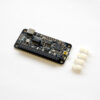
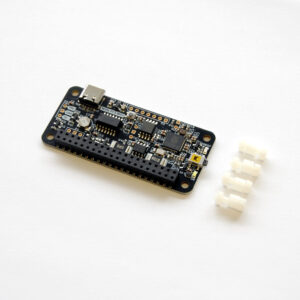
Each Witty Pi 5 Mini package contains:
- Witty Pi 5 Mini board × 1
- M2.5 × 10mm plastic screws × 4
- 3.5mm plastic spacers × 4
- M2.5 plastic nuts × 4
Specifications
| Item | Specification |
|---|---|
| Dimensions | 65mm × 30mm × 6mm |
| Weight | 12g (net weight without accessories) |
| Microcontroller | RP2350 |
| Flash Memory | 16MB external flash |
| Realtime Clock | RX8025T-UB |
| Temperature Sensor | TMP112 |
| DC/DC Converter | Not onboard; optional external converter supported |
| MOSFET Switch | AO4805 |
| RTC Backup | 0.07F/3.3V supercapacitor |
| Power Input | Regulated DC 5V via USB Type-C or an external DC/DC converter |
| Output Current | Up to 3A for Raspberry Pi and its peripherals |
| Standby Current | Approximately 0.4mA during hibernation, powered via USB 5V, after the supercapacitor is fully charged |
| Operating Temperature | -30°C to 80°C |
| Operating Humidity | 0–80% RH, non-condensing, no corrosive gas |
| I²C Address | 0x51 (default) |
User Manual
For detailed instructions about hardware installation, software configuration, power management, schedule scripts, firmware updates, and I²C registers, please refer to the Witty Pi 5 Mini User Manual.


Reviews
There are no reviews yet.